
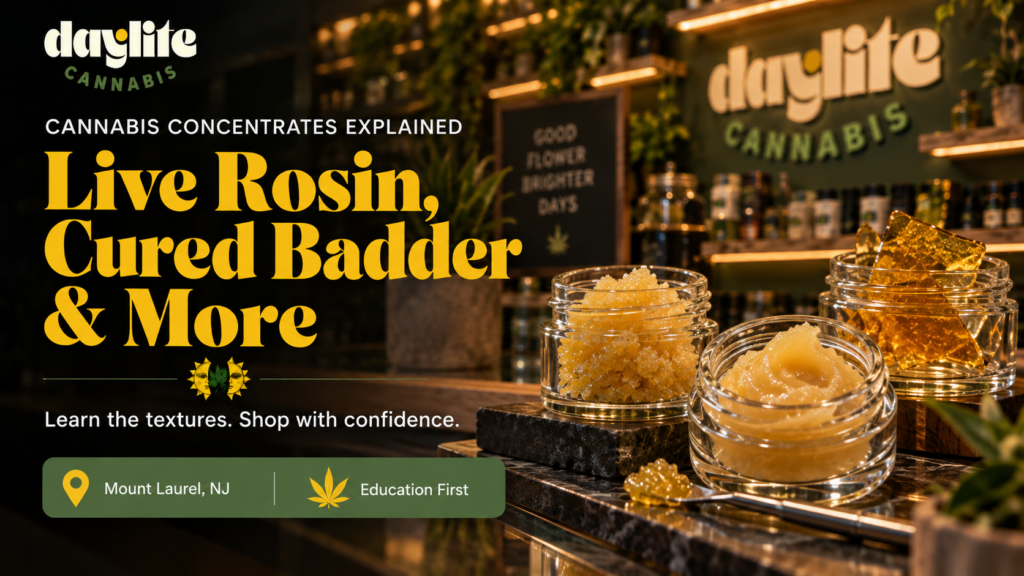
Key Takeaways
- Two questions decode any concentrate: fresh or cured, solvent or not.
- Live means the plant was frozen fresh, not dried.
- Rosin is solventless. Resin uses hydrocarbon extraction.
- Texture names like badder and sugar describe consistency, not quality.
- New Jersey caps one purchase at four grams of concentrate.
- Solventless is a craft choice, not a safety upgrade.
A concentrate case is the most intimidating display in any dispensary. Live rosin, cured badder, live resin sugar, diamonds, sauce, shatter. Every jar looks similar and the prices swing from twenty dollars to over a hundred.
Here is the useful part. Those names are not random. They follow a system, and once you know the system you can read any menu in the state.
Our budtenders in Mount Laurel, New Jersey explain this several times a day. Before you browse the concentrate selection, learn the two questions that decode the whole category.
For adults 21 and older. This article is educational only. It makes no medical claims and offers no dosage advice.
Start with those two questions.
Two Questions Decode Any Concentrate
Question one: was the plant fresh or cured?
Fresh-frozen plants go into the freezer right after harvest. The word “live” on a label means exactly this. Cured material dries and cures first, the same way flower does.
Fresh-frozen keeps more of the aromatic compounds. Cured material loses some of them during drying but often costs less.
Question two: did the process use a solvent?
Hydrocarbon extraction uses butane or propane to pull the good stuff out. Those products carry the word resin. Live resin, cured resin badder, live resin sugar.
Solventless extraction uses only ice water, heat, and pressure. Those products carry the word rosin. Live rosin, hash rosin, bubble hash.
Combine the two answers and any label makes sense. Live rosin means fresh-frozen plant, no solvent. Cured badder means dried material, hydrocarbon extraction, whipped texture.
That last word deserves its own section, because texture confuses people most.
The Texture Glossary
Texture describes consistency, not quality. A great extract and a mediocre one can share a texture.
| Name | What it looks like | How it got that way |
|---|---|---|
| Shatter | Hard, glassy, snaps | Left undisturbed while purging |
| Badder or batter | Whipped, cake-frosting texture | Agitated during the purge |
| Sugar | Wet, granular, crystals in oil | Natural separation over time |
| Sauce | Runny oil with crystals suspended | Separated on purpose |
| Diamonds | Visible crystal structures | Slow crystallization of THCA |
| Live resin | Any texture, fresh-frozen input | Hydrocarbon extraction |
| Live rosin | Usually badder-like, sometimes jam | Ice water hash, then heat and pressure |
| Bubble hash | Loose, sandy, or pressed | Ice water agitation and screening |
Badder and batter mean the same thing. Different producers just spell it differently.
Now for the assumption almost every shopper makes about solventless.
Expert Insight: Solventless Is a Craft Choice, Not a Safety Upgrade
Ask around and you will hear that solventless is the clean option and hydrocarbon extracts are the risky one. That framing does not survive contact with the actual regulations.
Every concentrate sold at a licensed New Jersey dispensary gets tested for residual solvents against published action limits. The CRC testing guidance sets specific ceilings for inhalable products, including butane at 800 parts per million and benzene at just 1 part per million. Product that exceeds those limits does not reach a shelf. The same document sets limits for pesticides, heavy metals, and microbials.
So what are you actually paying for with live rosin? Flavor and craft. Solventless production requires better input flower, produces lower yields, and preserves the aromatic profile differently. Those are real reasons to spend more.
What you are not buying is protection from something the licensed market already screens for. Anyone selling you solventless on safety grounds is selling you a feeling, not a fact.
That same document contains a detail that explains a number you will see on labels.
What to Actually Read on the Jar
- The input. Fresh-frozen or cured. This drives aroma more than anything else.
- The terpene percentage. New Jersey caps terpenes in inhalable concentrates at 10 percent of the product, so that is the practical ceiling you will see.
- The cannabinoid panel. THCA content, plus any minor cannabinoids present.
- The packaged-on date. Concentrates degrade. A jar from last spring is not the same product it was.
- The producer. Extraction skill varies enormously between brands, and it shows.
Terpene content matters more than most shoppers realize. Research suggests terpenes contribute meaningfully to how cannabis behaves alongside THC. The research is still developing, so nobody should promise you a particular result.
Pricing follows the process. Here is roughly how the tiers stack up.
| Tier | Typical products | Why the price sits there |
|---|---|---|
| $ | Cured badder, cured shatter, distillate-based | Cheaper input, higher yield |
| $$ | Live resin, live resin sugar, diamonds and sauce | Fresh-frozen input, more handling |
| $$$ | Live rosin, hash rosin, premium bubble hash | Top-shelf input, low yield, solventless |
Ask for current menu prices. They move constantly.
One more thing to know before you shop.
Buying Concentrates in New Jersey
The state limits how much you can take home. A dispensary may sell you up to four grams of solid concentrate in a single transaction, or the liquid equivalent.
Everything on the shelf cleared independent lab testing first. Packaging must be child-resistant, and products get tracked through the supply chain, as the CRC covers in its consumer guidance.
Storage is on you after that. Keep concentrates cool, dark, and sealed. Heat and air are what turn a bright live rosin into something flat and dull.
Frequently Asked Questions
Is live rosin the same as live resin?
Live rosin and live resin are different products. Both start with fresh-frozen plant material. Rosin uses ice water, heat, and pressure with no solvent. Resin uses hydrocarbon extraction. Rosin typically costs more.
Are cured badder and live badder different?
Cured badder and live badder differ in the input material. Cured uses dried and cured plant material. Live uses fresh-frozen. Both can share the same whipped texture, and both are hydrocarbon extracts.
Is a higher THC percentage better in concentrates?
THCA content is one measure among several. Terpene content, input quality, and extraction skill all shape the experience. Many experienced buyers choose a lower-testing live rosin over a higher-testing distillate.
Are dabs and concentrates the same thing?
Dabs describe how you use a concentrate, not what it is. Wax dabs, live resin, badder, and shatter are all concentrates. Dabbing is the vaporization method applied to them.
Is bubble hash a solventless product?
Bubble hash is solventless. Producers agitate plant material in ice water, then screen out the resin glands. Pressing bubble hash under heat produces hash rosin.
Conclusion
Concentrates stop being confusing once you sort them by two questions. Fresh or cured. Solvent or solventless. Texture names are just descriptions of consistency.
Read the input, the terpene number, and the date. That is the whole skill.
For adults 21 and older. This content is educational and makes no medical claims. Cannabis affects people differently, and nothing here is dosage guidance. Talk to a licensed medical professional about your personal situation, especially if you take other medications.
Come Look at the Jars
Concentrates are worth seeing in person. Our budtenders will show you the difference between a cured badder and a live rosin, pull up the lab results, and tell you the packaged-on date without being asked. Browse the concentrate menu at Daylite Cannabis before you visit, or stop by our Route 73 shop in Mount Laurel.