
Key Takeaways
- A cart needs a battery. A disposable includes one.
- Disposables cost less upfront and more per gram.
- The oil inside matters more than the housing around it.
- Live rosin is solventless. Live resin uses hydrocarbon extraction.
- Distillate carts usually get their flavor from botanical terpenes.
- Buy from licensed shops only. The lab testing is the point.
Two products sit next to each other on the counter. One is a half-gram THC vape cart for twenty-five dollars. One is a two-gram disposable for fifty. Both say the same strain name on the box.
That decision is not really about price. It is about whether you want control over your hardware, and whether you care more about flavor or convenience. Both answers are valid.
Our budtenders on Route 73 in Mount Laurel, New Jersey have this conversation twenty times a day. We stock both formats from brands like Fernway, Airo, and Timeless. Before you browse our vape cart selection, here is the framework we use on the sales floor.
*For adults 21 and older. This article is educational only. It makes no medical claims and offers no dosage advice.*
Start with the simplest difference, because it drives everything else.
What Actually Separates a Cart From a Disposable
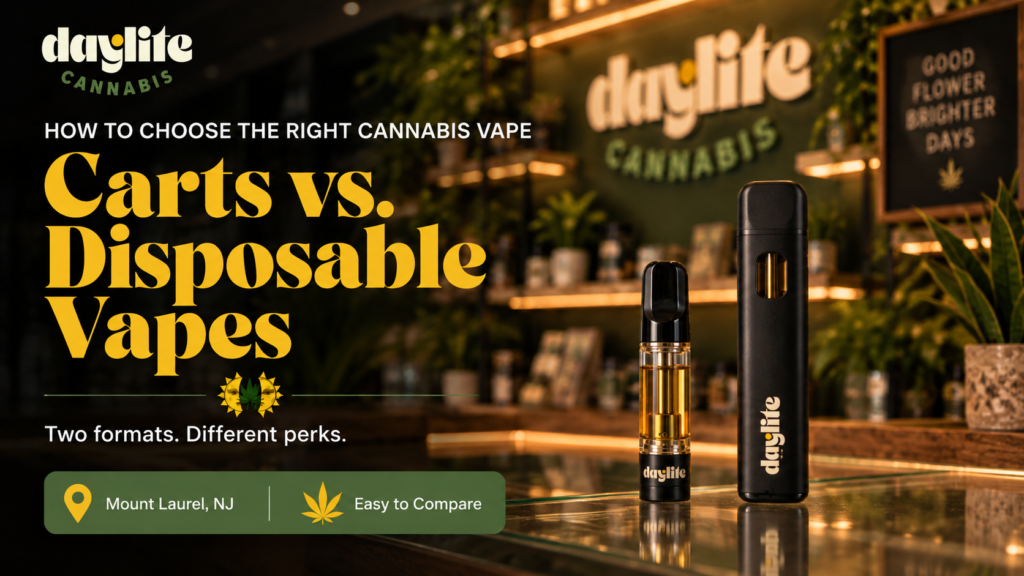
A THC vape cart is just a tank. It screws onto a separate 510-thread battery that you buy once and keep.
A disposable is a sealed unit. Tank, coil, and battery ship together, and the whole thing goes in the trash when the oil runs out. Most modern disposables are rechargeable, which means the battery outlasts the oil instead of dying at seventy percent.
That difference sounds small. It decides your cost curve.
Carts front-load the expense. You pay once for a decent battery, then buy oil at a lower price per gram over time. Disposables spread the cost out and charge you for new hardware every single time.
There is a second difference most guides skip.
Batteries with variable voltage let you dial in temperature. Lower heat brings out flavor. Higher heat brings bigger clouds. Almost no disposable gives you that control because the manufacturer locked the voltage at the factory.
Hardware settled, look at what is actually in the tank.
The Oil Inside Matters More Than the Shape
Three extraction styles dominate New Jersey menus. They taste nothing alike.
| Oil Type | How It Is Made | Terpene Source | What to Expect | Typical Price |
|---|---|---|---|---|
| Distillate | THC refined until nearly everything else is stripped out | Usually botanical, added back after | Clean, sweet, very consistent | $ |
| Live resin | Hydrocarbon extraction from fresh-frozen plant material | Cannabis-derived | Fuller, closer to the flower | $$ |
| Live rosin | Heat and pressure only, no solvent used | Cannabis-derived | Most true to the plant | $$$ |
Live rosin is what people mean by solventless carts and solventless vapes. No butane, no propane, just a press. It costs more because the yield is lower and the input flower has to be excellent.
Live resin disposables sit in the middle. You get real cannabis-derived terpenes without the rosin price.
That terpene distinction is where most shoppers get quietly misled.
Expert Insight: The Strain Name on a Distillate Cart Is a Flavor, Not a Plant
Here is a test you can run at any dispensary in New Jersey. Buy three distillate carts from the same brand with three different strain names. Then compare them.
Many will taste like variations on the same candy. That is because distillate strips out nearly all of the original terpenes, and the producer adds flavor back afterward. When those terpenes come from botanical sources rather than cannabis, the strain name on the label describes a flavor recipe, not necessarily the plant the oil came from.
Terpenes are not decoration. Research suggests they contribute meaningfully to how cannabis behaves alongside THC. The research is still developing, and nobody should promise you a specific outcome. But if you want the strain name to mean something, the label needs to say cannabis-derived terpenes.
Live resin and live rosin products almost always use cannabis-derived terpenes. Many lower-cost distillate products do not, and the package may not make the distinction obvious.
Ask the budtender. The answer should also be available through the product’s certificate of analysis.
Carts vs. Disposables: The Honest Comparison
Now put the two formats side by side.
| Factor | THC Vape Cart | THC Disposable |
|---|---|---|
| Upfront cost | Higher, battery required | Lower, nothing else to buy |
| Cost per gram over time | Lower | Higher |
| Temperature control | Yes, with a variable battery | Rarely |
| Hardware failure risk | Swap the cart, keep the battery | Lose the oil with the device |
| Travel and discretion | Two pieces to carry | One sealed unit |
| Waste | Minimal, battery is reused | A battery is discarded each time |
| Best for | Regular use, flavor chasers | Occasional use, trying a new brand |
Neither wins outright. Here is how the choice usually breaks down.
- Vaping several times a week? Buy a good 510 battery and stick with 1g vape carts or 2g vape carts.
- Vaping a few times a month? A disposable may make more sense. You probably will not miss the temperature control.
- Chasing flavor? Consider live rosin in either format and use a lower voltage when the hardware allows it.
- Trying a brand for the first time? A half-gram disposable can be an easy way to test it without committing to a larger format.
- Traveling? One sealed piece is simpler to carry than a battery plus a loose cart.
One rule applies no matter which you pick.
Buy Licensed. That Line Is Not Marketing.
The 2019 vaping lung injury outbreak is the reason this section exists.
CDC investigators found that vitamin E acetate, a thickening agent, was strongly linked to those cases and that patients overwhelmingly obtained their THC products from informal sources, including dealers and friends rather than licensed retailers.
Be clear about what that means. CDC guidance at the time advised against THC vaping products generally, not only illicit products, and the FDA continues to provide guidance about vaping-related lung injuries. We are not going to tell you the agencies said something they did not.
What we can tell you is that regulated cannabis products sold through licensed New Jersey dispensaries are subject to state testing and compliance requirements before reaching the shelf. Products purchased through unregulated sources do not come with the same regulatory safeguards.
New Jersey also limits how much cannabis consumers can purchase in a single transaction. The New Jersey Cannabis Regulatory Commission allows up to four grams of solid cannabis concentrates or equivalent cannabis products as part of the state’s adult-use purchase limits.
Frequently Asked Questions
Are THC disposables more expensive than carts?
Disposables are generally cheaper upfront and more expensive per gram over time. You pay for new hardware with every purchase. A reusable 510 battery costs more once, then lets you purchase compatible carts without buying another battery each time.
Is live rosin better than live resin?
Live rosin is solventless and typically made using heat and pressure. Live resin uses hydrocarbon extraction. Rosin usually costs more and is often chosen by consumers looking for a product that stays closer to the plant’s original profile. Which one is better depends on your budget and priorities.
Are all disposable THC vapes rechargeable?
No. Many current disposables are rechargeable, but not all of them are. A non-rechargeable unit can potentially lose power while oil is still inside. Check the packaging or device for a charging port before you buy.
Is a 2g vape cart a better value than a 1g?
Two-gram vape products can lower the price per gram, but they also remain in use longer. Consumers who vape more frequently may get more value from the larger size, while occasional users may prefer a smaller format.
Are dispensary vapes lab tested in New Jersey?
Cannabis products sold through licensed New Jersey dispensaries are subject to state testing requirements before retail sale. Testing can include potency and screening for contaminants such as pesticides, heavy metals, microbes, and residual solvents.
Conclusion
The cart versus disposable question comes down to how often you vape and how much control you want.
But the oil inside matters more than either housing.
Extraction method, terpene source, hardware quality, and lab testing are the details worth checking before you pay. If cannabis-derived terpenes matter to you, look at the label and ask the budtender about the product’s certificate of analysis.
A knowledgeable dispensary should be able to help you understand what you are buying.
For adults 21 and older. This content is educational and makes no medical claims. Cannabis affects people differently, and nothing here is dosage guidance. Talk to a licensed medical professional about your personal situation, especially if you have respiratory concerns or take other medications.
Come Compare Them Side by Side
We would rather you hold both formats and ask questions than guess from a website.
Our budtenders can help you compare carts and disposables, review available product information, and point you toward the format that fits how often you actually vape.
Browse the vape menu at Daylite Cannabis before you drive over, or stop by our Route 73 shop in Mount Laurel.